Czech-Ukrainian Bilateral Trade Relations 2023
Sat, 4 Jan, 2025

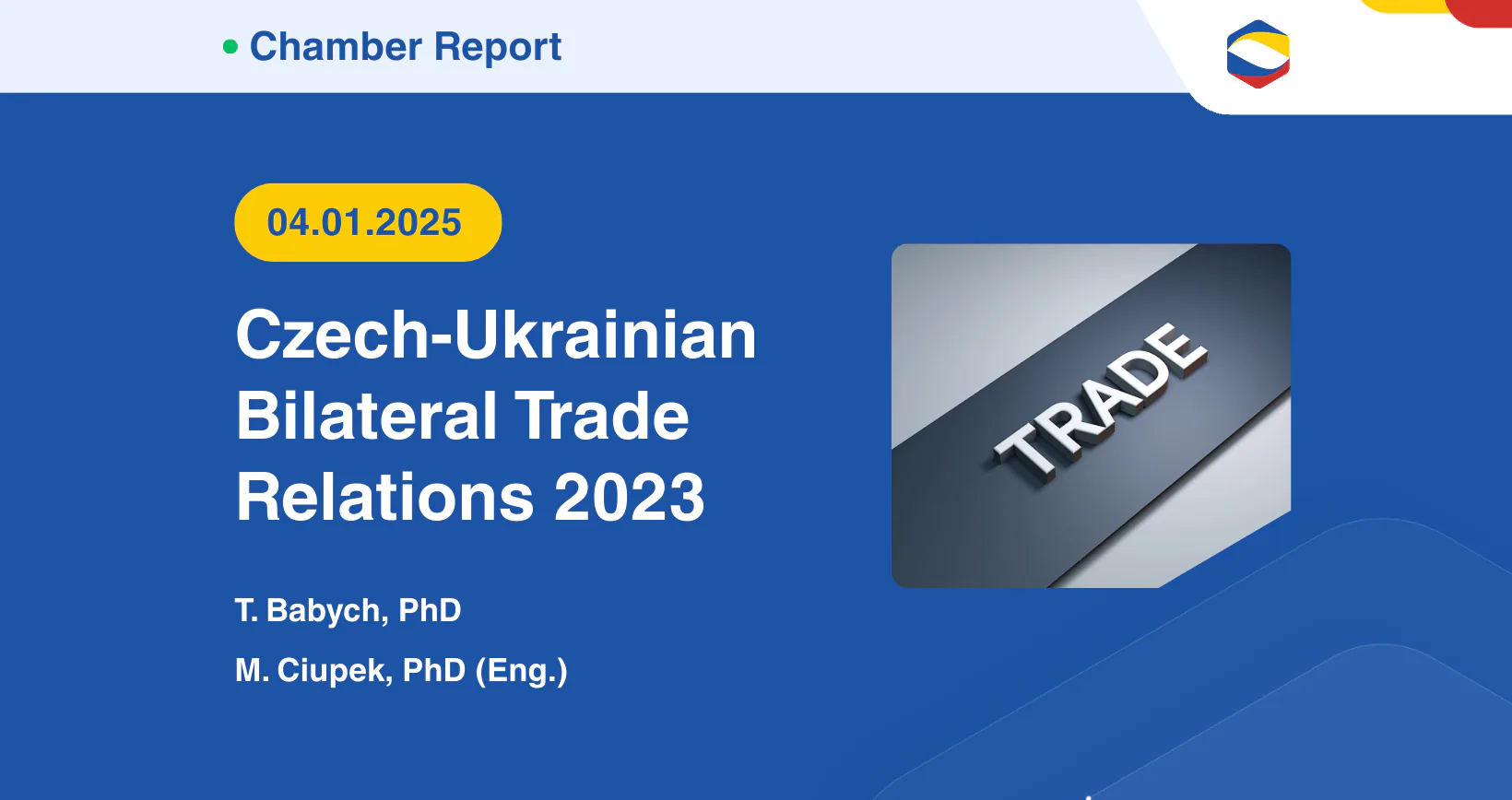
Relations between Ukraine and the Czech Republic are a key component of their economic diplomacy. As a member of the European Union, the Czech Republic holds significant importance for Ukraine, particularly in the context of European integration and economic cooperation.
Following Ukraine’s independence referendum on December 1, 1991—when an overwhelming majority voted in favor—the government of Czechoslovakia officially recognized Ukraine’s statehood at an extraordinary meeting on December 8. Ukraine later recognized the newly established Czech Republic on January 1, 1993. Diplomatic relations were formally established on January 3, 1993.
During the full-scale war, the Czech Republic has provided Ukraine with military equipment and vehicles, while importing Ukrainian iron ore, electrical cable, and agricultural products. Since the onset of the Russian invasion, the Czech Republic has emerged as a major military support partner, while continuing to serve as a traditional supplier of automotive equipment and consumer goods. As Ukraine’s mining enterprises face challenges exporting to other regions, Czech steel mills have become increasingly important consumers of Ukrainian iron ore.
The Czech Republic is one of Europe’s most industrialized countries. The industrial sector accounts for approximately 33% of the country’s GDP. The Czech Republic’s principal industries include mechanical engineering (primarily automotive), electrical engineering, the chemical industry, metallurgy, the food industry, pharmaceuticals, and others. Exports contribute to more than 72.7% of the Czech Republic’s GDP.
Ukraine and the Czech Republic share a longstanding history of commercial cooperation. Key areas of collaboration include:
Energy cooperation, focusing on energy supply and conservation
Joint efforts in mechanical engineering, chemistry, and metallurgy
Investments in transportation infrastructure and logistical facilities
The commodity structure of Czech exports is dominated by vehicles and other mechanical engineering products (58.4%), semi-finished products and materials (12.9%), chemical industry products (10.9%), industrial and consumer goods (7.0%), and food products and live animals (8.9%).
Such a strong production and export potential significantly shapes the state and trends of foreign trade with Ukraine.
The volume of commerce between Ukraine and the Czech Republic has been steadily increasing over the last decade. Since they do not share a border, trade and transit occur primarily through Poland and Slovakia.
According to data from Ukraine’s Embassy in the Czech Republic, the Czech Republic ranks seventh among European nations in terms of bilateral trade volumes with Ukraine, underlining its strategic importance as a commercial partner. The Czech Republic accounts for 4.65% of Ukraine’s total trade with European countries, highlighting its significant role in Ukraine’s economic relations.
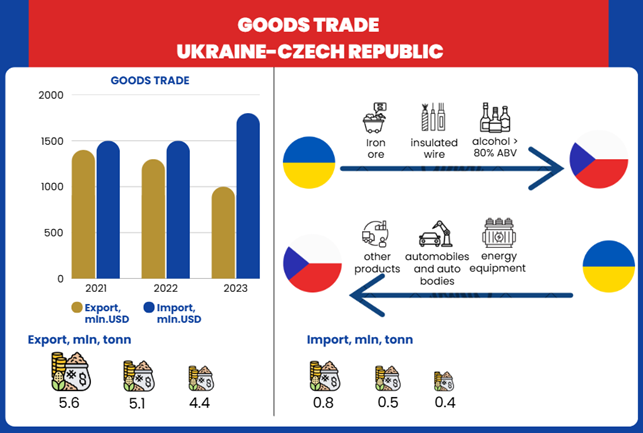
In goods trade, Ukraine remains a net importer. Although Ukrainian exports to the Czech Republic nearly doubled in pre-war 2021, they declined in 2022–2023. In 2023, exports totaled only $995 million, down 21% to 4.4 million tons in physical volume. Major exports included iron ore ($394M), insulated wire ($159M), and alcohol over 80% ABV ($35.6M).
In contrast, imports from the Czech Republic have been rising, reaching $1.8 billion in 2023—nearly double the value of exports. Though physical volumes dropped by 55% to 0.35 million tons, monetary value increased by 20% compared to 2021.
Over the past five years, Czech exports to Ukraine have grown at an annual rate of 3.92%. The largest imported items include “other products” (approx. $540M, often interpreted as military goods), automobiles ($139M), auto bodies ($45M), energy equipment ($56M), cleaning ($42M), and hygiene products ($39M).
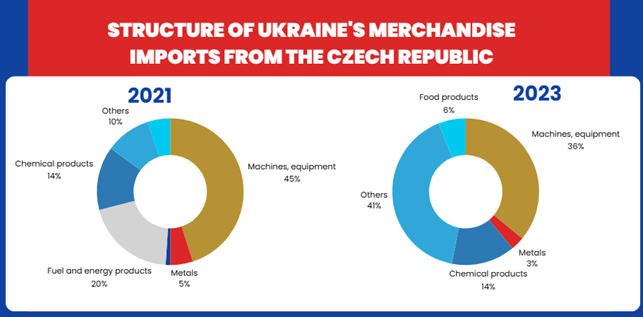
Following the war, Ukraine’s commodity structure in international trade with the Czech Republic became less diverse. In commodity imports, the share of medium-high-tech items—such as mechanical engineering, and the chemical and petrochemical sectors—remained substantial, accounting for 50% in 2023 (down from 60% in 2021). However, imports of mechanical engineering products declined from 45% to 36%, while fuel and energy products dropped significantly from 20% to just 1.6%.
Ukraine remains a net importer of various high-value commodities from the Czech Republic, particularly in mechanical engineering, chemical, petrochemical, and pharmaceutical sectors, as well as in light industry.
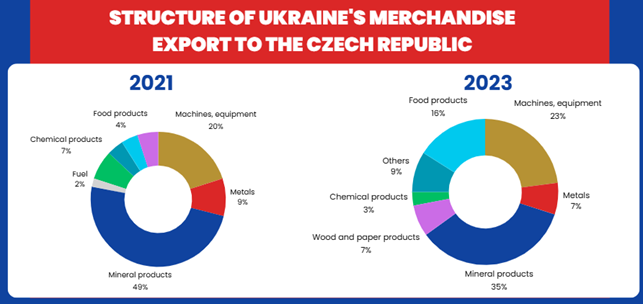
In contrast, Ukrainian exports continue to be dominated by raw materials and low-tech goods, which made up over 65% of total exports in 2023 (compared to 70% in 2021). Most notably, mineral goods, especially iron ores and concentrates, remained Ukraine’s top export. Their market share declined from 49% to 35% between 2021 and 2023, but the raw material export share remained high due to the rising share of agricultural raw materials and food products, which grew from 4% to 16%.
Meanwhile, mechanical engineering rose slightly (from 20% to 23%), and the woodworking sector also increased (from 5% to 7%), showing modest diversification in Ukraine’s export structure.
The negative balance of foreign trade in goods in 2023 reached a record high of $783 million. That year, Ukrainian exports to the Czech Republic exceeded imports in physical volume by 12 times, yet were 44% lower in monetary terms.
This imbalance highlights that Ukraine supplies the Czech Republic with the majority of raw materials, including iron ore ($349 million, accounting for 85% of total physical exports), cable ($157 million), rapeseed ($32 million), and sugar ($20 million).
Ukraine also exports smaller volumes of agricultural goods, foodstuffs, industrial raw materials, timber products, and consumer goods.
In return, the Czech Republic supplies Ukraine—though in much smaller physical quantities—with plastic products, paper and cardboard, various industrial products, consumer goods, and machinery, including mechanisms and appliances.
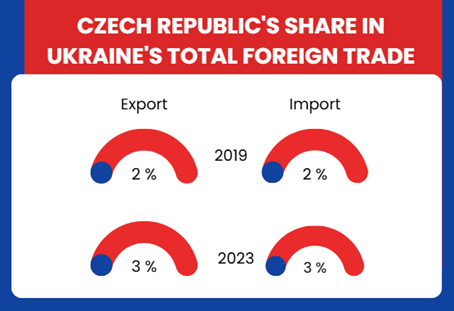
The share of Czech goods remains relatively low in both Ukraine’s total foreign trade in goods and its trade with EU countries. In the overall structure of Ukrainian exports and imports, Czech goods have fluctuated around 2%, showing a modest upward trend—from 1.9% in 2019 to 2.8% in 2023.
In contrast, the Czech Republic’s share in Ukraine’s trade with the EU has remained stable over the past five years, ranging between 4–5%. According to 2023 data, the Czech Republic ranks 7th in terms of bilateral trade in goods between Ukraine and European countries.
These statistics highlight the significant potential for further economic cooperation, which could strengthen mutually beneficial relations between Ukraine and the Czech Republic in the future.
As Ukraine transitions from wartime resilience to reconstruction, Czechia is emerging as one of its most strategic and committed economic partners. Between 2022 and 2024, bilateral trade not only recovered but surpassed pre-war levels, reaching $2.78 billion in 2023 — with Czech exports growing by over 40%. This strong momentum lays the foundation for deeper collaboration in 2025 and beyond.
Key sectors such as energy, defense, infrastructure, agriculture, and healthcare have become pillars of cooperation. Czech companies are actively engaged in rebuilding Ukraine’s energy grid, co-producing military equipment, modernizing hospitals, and delivering water purification systems. Investments in renewable energy, smart technologies, and agribusiness are increasing, while projects like the Central European Hydrogen Corridor signal a shared commitment to a sustainable future.
The Czech government continues to play an enabling role — securing €188 million in EU-backed guarantees and launching platforms like “Export for Reconstruction of Ukraine” to support companies entering the Ukrainian market. Over 200 Czech firms are already involved in reconstruction, forming joint ventures and co-investing in Ukraine’s recovery.
The outlook for 2025 is defined by opportunity, resilience, and strategic alignment. With strong political support, funding mechanisms, and clear sectoral priorities, Czech–Ukrainian partnerships are poised not only to accelerate Ukraine’s recovery but to reshape regional supply chains and innovation ecosystems. This collaboration is no longer just about aid — it is about co-creating a stronger, more integrated European future.
"Czech-Ukrainian Bilateral Trade Relations 2023"