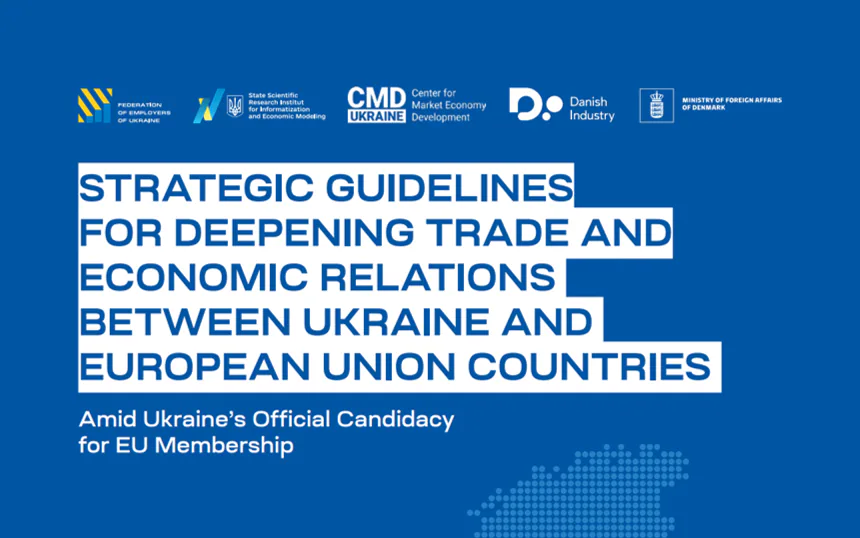
This 200-page landmark study, Strategic Guidelines for Deepening Trade and Economic Relations between Ukraine and the European Union Countries, is essential reading for anyone seeking to understand Ukraine’s evolving role in Europe’s economic and geopolitical landscape. Published by the Federation of Employers of Ukraine in 2025, it offers a comprehensive, data-driven roadmap for Ukraine’s EU integration—at a time when war, reconstruction, and realignment are reshaping global trade.
The report not only assesses Ukraine’s current export potential and industrial capacity but also presents forward-looking strategies for aligning with the EU’s goals of open strategic autonomy, resilience, and green transition. It provides deep insights into bilateral trade dynamics, sectoral strengths, and how Ukraine can replace imports from Russia and other high-risk partners.
Drawing from economic modeling, business surveys, and policy analysis, the study reveals how Ukraine can transform from a war-affected economy into a strategic pillar of Europe’s future. Whether you are an investor, policymaker, business leader, or analyst—this study offers vital knowledge for engaging with Ukraine’s industrial revival and its path toward full EU integration.
The updated analytical report “Strategic Guidelines for Deepening Trade and Economic Relations between Ukraine and the European Union Countries in the Context of Ukraine’s Acquisition of Official Candidate Status for EU Membership”, commissioned by the Federation of Employers of Ukraine (FEU) and supported by the Ministry of Foreign Affairs of Denmark, presents a timely and strategic framework for strengthening Ukraine–EU economic ties. Building on the 2021 FEU study, which assessed the first five years of the EU–Ukraine Association Agreement, this new edition responds to the dramatically changed geopolitical context following Russia’s full-scale invasion in 2022.
The report highlights how the war has catalyzed Ukraine’s economic pivot toward the EU. Despite severe disruptions—economic contraction, labor displacement, and logistical breakdowns—Ukrainian producers rapidly integrated into EU markets, benefiting from emergency liberalization measures. However, this shift has also brought challenges. Businesses now face complex EU regulations, decarbonization requirements, and mounting competition, necessitating robust support and coordination.
The EU, on its side, is grappling with its own vulnerabilities—geopolitical tensions, supply chain fragility, and climate imperatives. In this context, Ukraine emerges not only as a beneficiary but as a critical strategic partner in achieving Europe’s vision of open strategic autonomy.
The study combines macroeconomic modeling, sectoral surveys, trade simulations, and policy recommendations to propose a dynamic vision for Ukraine’s integration into the European economic area. It also includes a detailed analysis of untapped export potential, the prospects of nearshoring/friendshoring, and Ukraine’s capacity to supply critical raw materials, strengthen EU value chains, and contribute to industrial modernization.
Key Conclusions & Strategic Insights
War as a Catalyst for Integration: The full-scale invasion in 2022 accelerated Ukraine’s reorientation toward the EU, with the EU now accounting for 56% of Ukraine’s foreign trade. However, trade remains unbalanced: Ukrainian exports are mostly raw or low-value agricultural products, while imports are high-tech and capital-intensive goods.
$10 Billion Export Opportunity: Through simulation techniques, the study identifies $10 billion in untapped Ukrainian export potential, particularly in traditional sectors. These include non-ferrous metals, ethanol, fertilizers, rubber tires, rapeseed oil, and lighting equipment—products that could replace imports from Russia, Belarus, and risk-prone countries.
Export Diversification via Economic Complexity: The report uses economic complexity models to highlight medium-term diversification opportunities in machine-building, electrical equipment, rubber products, and processed non-ferrous metals.
Business Optimism Despite Challenges: A survey of 63 companies across 37 sectors revealed strong confidence in expanding exports to the EU. Wartime constraints like energy disruptions and skilled labor shortages persist, but EU markets remain vital, and free access must be preserved.
Ukraine as a Nearshoring & Strategic Autonomy Partner: Ukraine is uniquely positioned to support the EU’s friendshoring strategy, especially in critical materials (24 of 34 EU-designated critical materials are in Ukraine), aerospace, defense, ICT, and agri-food sectors—boosting resilience and lowering carbon transport costs.
Current Barriers to Address:
Imminent carbon emission charges under CBAM could block 15% of Ukrainian exports.
Reintroduced EU restrictions on poultry, cereals, and honey damage Ukrainian agribusiness.
The delay in implementing the ACAA agreement leaves high non-tariff barriers on Ukrainian industrial goods.
Domestic Policy for Export Readiness: Ukraine must strengthen internal policies through:
Industrial parks
Investment compensation schemes
Support for machinery and innovation
Trade representation abroad
Export financing, customs simplification, and localization
Strategic Messaging to the EU: Ukraine should demonstrate that EU needs Ukraine—as a partner for reshoring, reducing dependency on adversaries, and supporting EU food and industrial security. It must argue for:
Removal of barriers to agri-products
Postponement of CBAM obligations
EU co-financing of Ukrainian industrial zones
Simulated Economic Impact: If properly integrated into EU trade systems, Ukraine could:
Double GDP within a decade
Create 815,000 new jobs
Raise manufacturing’s GDP share from 7.6% to 20.4%
Boost exports by 195%, and reduce the GDP per capita gap with the EU from 7.1x to 3.2x
Future Research & Policy Direction: Further studies should focus on:
Ukraine’s industrial/export strategy in the context of EU accession
Customs policy alignment
Practical case studies of EU–Ukraine cooperation in critical sectors
Final Note
The report’s key message is clear: Ukraine’s integration into the EU economy is not a one-sided benefit, but a shared strategic necessity. By deepening cooperation, removing residual barriers, and investing in Ukraine’s industrial capacity, the EU stands to gain resilience, competitiveness, and long-term geopolitical stability—while helping Ukraine emerge from war as a modern, dynamic economic partner.